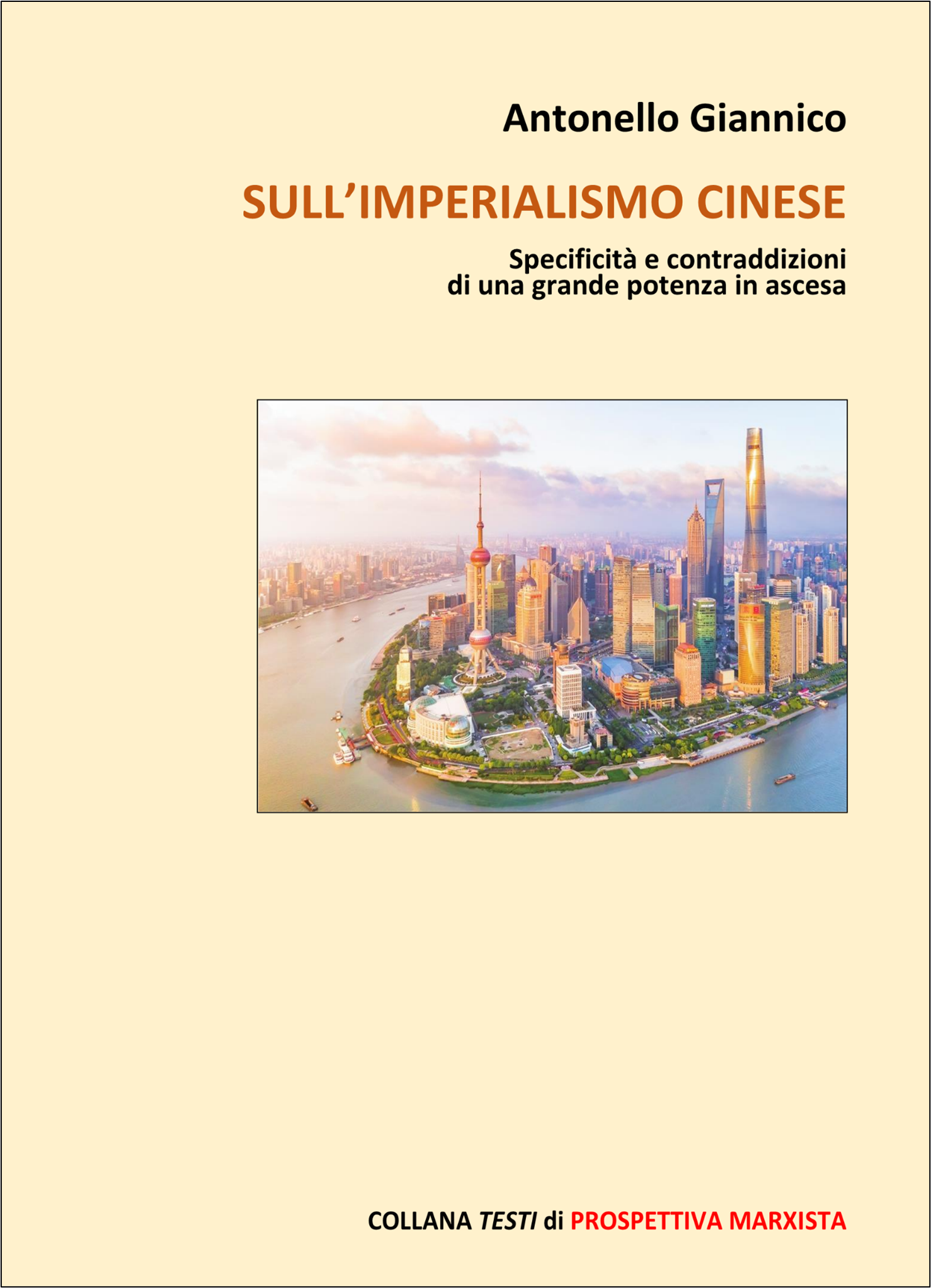
Specificities and contradictions of a rising great power

This text, which collects articles published in the journal “Prospettiva Marxista,” is the fruit, the synthesis of a 20-year study of China’s social reality. The economic and political rise of the Asian giant in global competition is undoubtedly one of the processes that are marking the contemporary era. Too often, however, it is encapsulated in schematic and stereotypical formulas. Too often the public debate around phenomena related to the emergence of Chinese power is encapsulated, especially in Italy, within hasty polarizations. Now China is portrayed as the unstoppable competitor of the United States, fatally destined to supplant American hegemony globally (if not already succeeding Washington in the role of hegemonic power) now as a giant with feet of clay, equally fatally undermined by innumerable frailties. Now China would embody a fateful squaring of the circle, with an unprecedented and successful weld between capitalist economy and “communist” political power (quotation marks obligatory since the author’s criterion of analysis is based on the recognition of the full capitalist social nature of the People’s Republic of China and the extraneousness of genuine communist revolutionary developments from its path of formation), now it would constitute a gigantic time bomb, resulting from the confrontation between a rigid and authoritarian political system and the dynamic heterogeneity of the economy and social fabric. In contrast, the common thread of the articles that make up this text can be traced precisely in concepts such as the complexity and contradictory nature of a historical path and economic and social reality, with an awareness of the importance of such a fundamental factor as unequal development within the Chinese space. In order to understand certain essential elements of the reality of a power that is pressing the world order, it is necessary to go beyond the surface of easy definitions, convenient simplifications. China shares the social essence, laws and general logic of the capitalist mode of production. But at the same time Chinese capitalism has developed on a specific historical and cultural background, understanding China today means understanding its common capitalist nature and at the same time its specificity. The effort to understand China must contemplate as much the political state synthesis that allows a growing imperialistic force to be projected onto the world theater as the multiple identities of a vast and diverse social reality. Precisely with this complexity in mind, the analytical instrumentation contained in this text goes so far as to address issues such as the drivers of China’s economic growth and at the same time the contradictions often hidden behind the apologetic celebration of this development, such as the conditions of the working class and the conflicts that accompany the trend of China’s increasing economic strength. The analysis even grapples with difficult, highly interesting and fundamental issues, such as the formation and changing persistence of a specific forma mentis in Chinese society, markedly different from that which has taken shape through other historical paths in Europe and in realities generally associated with the concept of the West. In this endeavor the author also draws on the contributions, filtered through the application of the Marxist method, of such scholars as Joseph Needham, Paul Kennedy and Angus Maddison. It is ultimately a work that serves as a valuable and documented tool for understanding and critiquing a historical phenomenon that has acquired a powerful centrality in the becoming of our times.
To request the [italian] text write to: redazione@prospettivamarxista.org
 circolo internazionalista "coalizione operaia"